- Please visit our social media pages


TEN YEARS ON A BREXIT DECADE IN FULL
Myra Cecilia Azzopardi — Citizens Advice Bureau Spain
Qualified Paralegal
1. THE BEGINNING — BEFORE THE VOTE 2016
Long before anyone was talking about Brexit, I was already deeply embedded in EU law. From around 2002, running an office assisting foreigners in Spain, I’d spent years cross-referencing EU directives against Spanish royal decrees, helping people navigate residency, healthcare, and succession matters that had nothing to do with politics, simply the ordinary, complicated business of living as a foreigner in Spain. That groundwork mattered later. At the time, it was just the work itself.
In February 2016, four months before the vote, I was already sharing the UK government’s own document on the Article 50 withdrawal process with members, not because anyone expected to need it yet, but because I wanted people to understand the actual mechanism, not just the politics, before they ever had to.
https://www.citizensadvice.org.es/the-process-for-withdrawal-from-the-european-union/
In May 2016, a few weeks before the referendum, I travelled to Brussels for the European Economic and Social Committee’s Civil Society Days, May 30–June 1. While I was there, I corresponded with Margaret Tuite, the Commission’s own coordinator for the rights of the child, about a real, specific problem: families in Spain who hadn’t been told they needed to apply separately for their children’s residency. She offered to meet in person on May 30th, but in the end the meeting itself never happened, I believe one of my replies went astray, possibly into a spam folder, and we lost the thread of it. Even so, just having that door open, offered so readily, said something about how differently Brussels treated these questions compared to London.
During those two days, I spoke myself on two separate occasions, on immigration, including Spain’s own immigration situation, and a concern I raised about grants given to Andalusia by the European Commission that I believed may have been misspent. I also met Henri Malosse, the EESC’s outgoing President. We chatted in his office, and I asked whether he’d be willing to be interviewed on a radio station back in Spain. He kindly agreed. Unfortunately, the person who was supposed to make that call on my side never did, a genuine mess-up, and a deeply embarrassing one for me, given how rude it must have seemed to someone of his standing. I also heard Pieter Cleppe, head of the Brussels office of Open Europe, speak, and wrote to him afterwards asking how Brexit might affect British expats in Spain. His reply, dated June 3, 2016, raised the Vote Leave campaign’s own pledge that any EU migrant already in the UK would be able to stay, and predicted that if that promise held and the eventual negotiation involved real reciprocity, the EU would likely extend the same courtesy to British nationals living in the EU. He also predicted a two-year “freeze” under Article 50, with everything remaining the same in the interim, until any new arrangement was actually agreed.
I still find it remarkable, looking back, how much warmth came from Brussels during that visit, and how little ever came from London. After the Civil Society Days ended, one of the EESC staff, Christian Weger, sent me the full audio and video recordings of both days, unprompted, along with photographs he’d taken of me speaking, just because he thought I’d enjoy having them. I wrote back at one in the morning, the night I got home, already missing Brussels and the European Commission. He wrote back offering to send me citizen’s guides in Spanish, completely unprompted, in case they’d be useful for the people I was helping back in Spain.
That’s not official protocol. That’s someone choosing to be generous, person to person. I think that’s part of why, when the UK government and its embassies gave us nothing at all over the years that followed, it never felt entirely surprising. I already knew, from this one visit alone, which side was actually listening.
The chamber where I spoke was the plenary chamber of the Jacques Delors building, the EESC’s headquarters in Brussels.
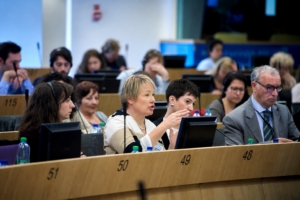
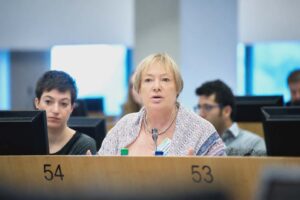
When a couple of people from one of the newly setup Brexit groups suggested I had no knowledge to run Brexit seminars, I thought of moments like these. My visits to Brussels were never just about Brexit long before that, I was already working with the institutions there, trying to assist our citizens in Spain. That’s simply my trajectory. People are entitled to their own opinion, but the record speaks for itself.
2. JUNE 24, 2016 — THE MORNING AFTER
I hadn’t slept. I’d followed the vote through the night, and by morning there was nothing left. I wrote “A Time for Reflection” in that state, and within hours I was live on Talk Radio Europe with Bill Padley, in an interview neither of us had planned. My voice was weak. Because of CAB’s neutral position, I could not say what I actually felt, even though I felt it very strongly.
The piece itself opens with calm legal grounding rather than panic, and closes with a line that still carries weight a decade on: “We are all still EU Citizens.”
https://www.citizensadvice.org.es/a-time-for-reflection/
3. JUNE 27, 2016 — FULL SPIRITS
Three days later, back with Bill Padley, mood completely shifted. He played “A Little Tenderness” before bringing me on, then a Farage clip to needle the conversation along. Healthcare for pensioners. A lady married 52 years jokes the train robber “only got 30 years.” An elderly man in his eighties, frightened, reassured directly. None of us knew yet that Spain would choose Article 18.4 over 18.1, not settled for another four years.
4. MARCH 29, 2017 — ARTICLE 50 TRIGGERED
Nine months after the vote. The joint letter to Theresa May from Citizens Advice UK, Martin Lewis, and Which. My own analysis of what was at stake: tax treatment, mortgage interest deductions, CGT, inheritance tax, citing an ECJ ruling against Spain’s own discriminatory inheritance tax on non-residents. Not theoretical.
https://www.citizensadvice.org.es/pm-trigger-article-50-today/
5. APRIL 3, 2017 — THE QUESTION NOBODY COULD ANSWER
“The mantra of ‘we do not know, let us wait and see’ does not suffice for us at CAB Spain.” I worked through how residency had been obtained via EU freedom of movement directives, and asked: if the right was granted because of EU citizenship, what happens when that citizenship-based right disappears? Including a quiet warning to people considering Irish nationality purely to preserve EU citizenship.
https://www.citizensadvice.org.es/post-brexit-will-still-meet-requirement-residence-conceded/
6 & 7. JULY 13 AND JULY 17, 2017 — THE BRUSSELS EXCHANGE
July 13th: a full clause-by-clause analysis of the UK government’s residency proposals, entirely on my own, no help. How “reciprocity” could mean Spain demanding reapplication for rights already held; how “settled status” wasn’t equivalent to automatic permanent residency under EU law; vague wording around paragraph 49 causing needless pensioner panic. I even corrected a misreading of the PM’s own statement to Parliament. I did not yet know which option Spain would choose.
I sent that paper directly to the EU’s Brexit Steering Group. Four days later, July 17th, they replied, echoing my concerns, in places, word for word. Not similar. Word for word. A direct exchange, not coincidence. I noted on the original article: “Received the answer to the UK proposal from the EU Brexit team.”
Their reply opened by quoting my own earlier work back at me: “Many will be aware that CAB Spain has been following movements since the referendum of June 24, 2016. It is imperative that we remain informed to be able to be prepared for all eventualities post Brexit.”
Over the years that followed, when I needed real answers, it was Brussels I turned to, Michel Barnier’s team or Guy Verhofstadt’s, the European Parliament’s Brexit coordinator. Members from these teams were patient, kind, and helpful. There was nowhere I felt I could turn to in the UK, even though I was under the impression they would be protecting our rights.
I deleted some the original email correspondence with Brussels at some point. I regret that now. All that remains are a few and what was published.
https://www.citizensadvice.org.es/assessment-brexit-steering-group-uk-policy-paper/
https://www.citizensadvice.org.es/wp-content/uploads/BSG_Position_on_UK_Paper_on_Citizens_rights.pdf
8. SEPTEMBER 3 & OCTOBER 13, 2017 — TWO LETTERS TO BRUSSELS
September 3rd: I emailed the British Ambassador asking for a meeting. No response, even though other consuls had met with remain/exit groups, just not us. Meanwhile the EU’s Brexit Negotiating Team responded to every email I sent. “It seems odd that though CAB Spain is looking for support… the only communication to date has been with the EU Brexit negotiating team who have responded to all my emails.” I asked members, pro and anti-Brexit alike, to add their names to a collective letter.
October 13th, six weeks later, sharper frustration after the fifth negotiation round. The UK’s settled status form: 85 pages, later reduced to “only” 60. I compared that to Spain’s own EX18: one side of A4. “This is not about leaving or remaining as the decision was made… This is about retaining our present resident status.” And: “I have written to the negotiating team in Brussels who will take note. Unfortunately we do not have a voice for our community in Spain.”
https://www.citizensadvice.org.es/u-k-nationals-spain-residency-rights-post-brexit/
https://www.citizensadvice.org.es/uk-government-continues-to-jeopardise-our-residency-rights/
9. DECEMBER 2017 — THE JOINT REPORT
Clause by clause through the EU-UK Joint Report, paragraphs 16, 22, 23. The pattern already establishing itself: civil servants asking people to reprove rights already held, certificates wrongly treated as expired. The same pattern that became the TIE and green certificate battles years later. At the bottom, I’d already listed my own previous posts on the subject, building this same retrospective myself, in 2017.
https://www.citizensadvice.org.es/near-brexit-withdrawal-date-eu-uk-progress-report/
10. NOVEMBER 4, 2018 — THE DRIVING LICENCE SAGA BEGINS.
The start of a fight that ran more than four years. Some civil servants didn’t understand that EU registration certificates don’t expire after five years. Not properly resolved until March 2023.
Voting Rights, Confirmed
Not every piece of this story was a fight. In January 2019, the UK and Spain signed a treaty confirming that UK nationals resident in Spain would keep the right to vote, and stand, in local elections, even in the event of a no-deal Brexit. It worked both ways: Spanish residents in the UK kept the same right there too.
Even before that treaty was signed, Spain’s own Electoral Census Office had already taken a quietly decent, cautious approach. Even as the UK moved toward its original exit date, the Office chose not to remove UK nationals from the electoral roll as a precaution, simply noting that their inclusion would lapse once departure actually took effect. It was a small thing, but it stood out against so much confusion elsewhere.
The practical work never really stopped, though, reminding people, year after year, that registration to vote doesn’t happen automatically, and that even people who’d voted before could quietly fall off the register and need to reconfirm their place on it, ahead of each election.
https://www.citizensadvice.org.es/voting-in-the-municipal-elections/
EUROPEAN REGULATIONS ON SUCCESSION
A quick note on something that comes up more than once in this piece: the EU Regulation on Succession, known as Brussels IV, came into force in August 2015. It allows you to choose which country’s inheritance law governs your estate, simply by writing the right clause into your will, for British nationals, that usually means electing the law of your nationality rather than Spanish law of succession.
https://www.citizensadvice.org.es/eu-regulations-succession-applicable-from-2015/
It was never affected by Brexit, because it was drafted for all residents of Spain, regardless of nationality, not for EU citizens specifically. And yet the belief has come up, even now, that since Brexit, this regulation no longer applies to UK nationals. It does. Brexit changed nothing about Brussels IV. I’ll come back to this a few times, because it’s one of the things people still misunderstand most.
11. JANUARY 3, 2019 — BREAKING MY OWN RULE
I’d avoided posting every no-deal notice, too many, most not worth alarming people over. But the UK government quietly dropped its usual hedge (“though we hope for an agreement”), and only 84 days remained. That language change told me something the content didn’t. “Will I still get my State Pension? Yes.”
https://www.citizensadvice.org.es/the-uks-exit-from-the-eu-important-information-for-uk-nationals/
12. FEBRUARY 18, 2019 — SOMEONE ELSE’S FEAR
Not my analysis, someone else’s fear, in their own words. A real (redacted) email exchange with the NHS Overseas Healthcare Team. “I understand that this must be quite stressful for you given the uncertainty surrounding Brexit. I am unable to provide you with any absolute answers… I wish I could give you more information or a better answer.”
https://www.citizensadvice.org.es/no-deal-brexit-and-concern-about-the-s1-and-ehic/13.
OCTOBER 8, 2019 — THE DGT WARNING
Spain’s traffic authority quietly published instructions contradicting their own Royal Decree. No Spanish press coverage, no UK warning either. A CAB volunteer spotted it first; I cross-checked it myself against the official DGT and Moncloa websites.
https://www.citizensadvice.org.es/warning-dgt-instructions-on-uk-driving-licences-post-brexit/
14. AUGUST 2 & AUGUST 16, 2019 — THE GAP, AND THE TRIP TO IRELAND
August 2nd: UK nationals married to EU/Irish citizens, holding residency cards because of that marriage, weren’t mentioned in Spain’s no-deal contingency plan. I noticed that Spain’s, Moncloa website had quietly added this group to its planning, without any clear announcement, so I gave it a name myself calling it group, 5 to make sure people understood there was now somewhere for them in the official picture, even informally.
August 16th: I flew to Bantry, County Cork, and met Sylvia Adamska and Martina Conroy at Citizens Information Ireland in person, working out what UK/Irish couples in Spain should do, since Irish citizenship by marriage wasn’t realistic for most: an 18-month backlog, a 3-year residency requirement most hadn’t met, no provision for de facto partnerships. Two advice organisations, two countries, solving one real problem for real couples.
15. DECEMBER 13, 2019 — LOOKING BACK, MID-JOURNEY
The election result made no-deal look certain, and that night I thought back to June 2016 again. Whatever our own views on Brexit, and we all had them, CAB never let that show. eventually we sat on panels with British Embassy and Consulate staff and never pandered to either government. “We pride ourselves in being able to remain impartial with citizens’ wellbeing as our only concern.”
https://www.citizensadvice.org.es/uk-election-results-residency-rights-update/
16. JANUARY 29, 2020 — THE PHONE CALL TO BRUSSELS
A week from actual departure, with a deal. The full practical checklist, but the part that mattered most: a gap in our knowledge about holiday-home owners, outside the Withdrawal Agreement entirely. So we simply telephoned the European Commission’s Europe Direct line. By the next morning, an answer. Once UK nationals became third country citizen, so would still be able to visit visa free for 90 days and only 180 day., The same short stays rule that applies to other non-EU visitors taking affect either on a no do exit date, or at the end of the transition period.
17. JULY 6 & JULY 8, 2020 — TWO DAYS, TWO VERY DIFFERENT FIGHTS
July 6th: I challenged Spain’s own published residency instructions against the actual Withdrawal Agreement and EU Directive 2004/38. “Possession of a residence document is not a prerequisite for lawful residence in accordance with Union law because under Union law the right of residence is conferred directly on EU citizens by the Treaty.” We emailed the European Commission and Parliament the same day.
The contact I emailed that day was Philippe Bertrand, of the European Commission’s support team led by Michel Barnier Task Force. My email to him read, in part:
“Spain is incorrectly implementing the Withdrawal Agreement as regards those arriving during the transition period… Spain has chosen the declaratory system under article 18.4 of the Agreement. Their instructions for those who have and will arrive during the transition period is not in accordance with the Agreement.”
His reply came back the same way Brussels always did, promptly, and substantively, though not as a simple validation of everything I’d argued. He wrote:
“Please note that the procedure Member States have to establish under Article 18(4) of the Withdrawal Agreement does not have to be exactly the same as the one they use to implement the EU Free Movement Directive… I would like to use this opportunity to assure you that the compliance of Member States’ implementation measures with the Withdrawal Agreement will be examined by the Commission.”
That’s the real texture of the relationship with Brussels, not always total agreement, but always genuine engagement, always a real answer, addressed to me by name. I still have this one. Not all of them survived, but this one did.
July 8th: the UK government funded three organisations in Spain to help with residency applications. CAB Spain, hands-on with UK nationals for years, wasn’t one of them. CAB Spain who were consistent in informing UK nationals were not included.” Still cross about that, if I’m honest. We did the work. We just weren’t the ones funded for it.
Throughout this whole period, alongside everything else, there was always the practical side too, simply helping people get the right document in their hands. In July 2020, I put together a short version of the Spanish Government’s own guide, alongside the official English-language version itself, so people preparing their TIE applications had everything they needed in one place.
https://www.citizensadvice.org.es/brexit-tie-applications-faqs-for-uk-nationals-and-their-families/
BETWEEN 17 AND 18 — THE FIGHT DIDN’T END WITH THE POLITICS
Through 2021, defending the same legal point again and again, against different institutions. In July, I publicly thanked SOLVIT — the EU’s own dispute-resolution network, for the assistance from my contact there over many matters. Another Brussels-level relationship, distinct from Barnier and Verhofstadt: the EU’s actual enforcement mechanism.
In September, banks still insisting on TIE cards despite the green certificate being legally valid — raised with the Spanish ombudsman and British Embassy directly. Weeks later, the Andalusian Employment Service made the same demand. “Despite the clamour from various administrative offices for proof of possession of a TIE, the green registration certificate remains valid.” Finally confirmed through the British Embassy in February 2022. Two years to make Spanish institutions honour their own government’s legal choice.
In October 2021, I wrote directly to the Cabinet of Commissioner Ylva Johansson, the EU’s Commissioner for Home Affairs, requesting a meeting on Schengen Borders and Freedom of Movement. I was redirected to Directorate-General Home Affairs and Migration, and told that Commissioners’ Cabinets only meet organisations registered in the EU’s Transparency Register, so I registered.
In November, I wrote directly to the Directorate-General for Justice and Consumers, in their Union Citizenship Rights and Free Movement unit, identifying myself as Founder and Senior Adviser of Citizens Advice Bureau Spain, also representing Citizens Advice International. I was attending an ECAS event in Brussels and asked to meet to discuss three ongoing concerns: travel complications for non-EU spouses of EU citizens, Spain’s immigration offices not properly accepting registration certificates as proof of permanent residence, and clarification on whether the Brexit-era family residency card was equivalent to the one issued under the EU’s Free Movement Directive.
A Legal and Policy Officer at DG Justice replied within days, apologising for the delay only because they’d been working out the best date internally, and arranged a virtual meeting on Webex for December 2nd with a colleague. I sent through four specific questions in advance. Two fell outside that department’s direct competence and were passed to colleagues at DG HOME instead; two were answered properly within DG Justice.
One answer is worth recording precisely, because it settles something people still get wrong even now: non-EU family members of EU citizens travelling to a member state other than the EU citizen’s own home country are not bound by the 90-day, 180-day rule at all. That limit only applies to the EU citizen’s own home country. The Free Movement Directive even entitles the family member to a free, expedited visa under an accelerated procedure, if one is needed.
This is one of the few full email exchanges that survived. Reading it back now, what stands out most isn’t just the answer itself, but the tone of the whole thing: prompt, careful, willing to admit what fell outside their own remit and pass it along rather than guessing, and happy to arrange a real conversation rather than a form letter. That’s the relationship with Brussels in miniature, preserved.
18. OCTOBER 9, 2025 — A DECADE, COUNTED
By October 2025: 186 Brexit articles on the site, 181 written by me. At one stage I was told, by the founder of a group only just formed during the process, that I had “no right” to give seminars on Brexit, despite covering it since before the referendum. I decided not to engage in rivalry. Experience doesn’t need to shout.
“There was nowhere I felt I could turn to in the UK even though I was under the impression that they would be protecting our rights.” Barnier’s team, and Verhofstadt’s, were patient, kind, and helpful, in a way our own government back home simply wasn’t.
Despite what some say, that Brexit is over, that we should get over it, the effects are still felt today: TIE renewals, no appointments, incorrect ministry information.
https://www.citizensadvice.org.es/a-decade-of-guiding-residents-through-brexit/
February 2025 — The Fight Isn’t Only in the Past
Even as this anniversary arrives, the work isn’t finished. In February 2025, I wrote about something still genuinely unresolved: the Withdrawal Agreement protects British nationals who were legally resident in Spain before December 31, 2020, but it says nothing about who they marry afterwards. If a British national in Spain marries a non-EU national after that date, their spouse isn’t covered by the Withdrawal Agreement at all, they’re pushed instead into Spain’s domestic family reunification rules, which are far stricter and far less certain.
In 2022, 293,171 British nationals were registered on Spain’s padrón. By a reasonable estimate, around 110,000 of them were unmarried at the time, meaning a very large number of people could eventually find themselves in exactly this position, with no warning that their future spouse would fall outside the protection they themselves still hold.
I argued then, and still believe now, that this exclusion was never a legal necessity, it was an arbitrary decision, and one that deserves to be challenged. Other parts of the Withdrawal Agreement have already been amended over the years. If change was possible there, the same should be true here. The question I asked then remains open now: why should family reunification be treated any differently?
It’s not just the past that’s unfinished. Even now, in 2025 and 2026, real problems are still surfacing for UK nationals under the Withdrawal Agreement, specifically around TIE cards that have expired or are stuck in renewal delays. People have come to us with refused renewals, employment refused because their card had expired, banking problems, difficulties travelling in and out of Spain, even healthcare or public service access affected, all because of a piece of plastic that simply hadn’t been renewed in time through no fault of their own.
We gathered these accounts directly from members, just the basic facts, to understand how widespread the problem really was. Not to campaign or challenge anyone with it, simply to document what was actually happening, in real time, to real people. People say Brexit is something finished, something to get over. But this is what it still looks like, a decade on: ordinary administrative failures, still landing on ordinary people, long after anyone assumed the story was over.
Besides everything else, officers have often been asking for the wrong form entirely, and refusing people who couldn’t provide it. The EX17 is for renewals under Spain’s domestic law. The EX23 is for renewals under the Withdrawal Agreement. It says so plainly, at the top of each form, anyone reading them carefully would see it immediately. And yet officers keep reaching for the EX17 when it’s the EX23 that actually applies, refusing renewals from people who simply don’t have the wrong document an official has wrongly asked for.
Separately, and far more seriously, this has escalated into something with real financial consequences. Some banks have begun asking members for a renewed TIE, and in at least a couple of cases, have raised the possibility of freezing accounts over an expired card. If your TIE has expired but you’re covered by the Withdrawal Agreement, your residency remains valid regardless, the card itself is just a document, not the source of the right. A bank freezing an account on that basis may be acting unlawfully, and it could amount to discrimination. These renewal delays are very often caused by the system itself, not by anything the person has done wrong.
I’m already drafting a letter in Spanish for members to give to their banks, the same way I did years ago when banks were wrongly telling people their green certificates were no longer valid. The advice is the same now as it was then: stand your ground, and ask the bank to put any action or refusal in writing.
TEN YEARS TO THE DAY — JUNE 24, 2026
The Closing Interview
Myra Cecilia Azzopardi — Citizens Advice Bureau Spain
June 24, 2026
Interview
Q1: What made you start writing about EU law years before anyone was talking about Brexit?
I had set up an office assisting expats with residency applications, which was much in the forefront at the time. So I started by reading the Freedom of Movement Directive, 2004/38/EC, I still have it in my head. It went from there; I had to cross-reference it with the Spanish Royal Decree. It interested me,I think when I was younger I’d thought about law, in fact. A lawyer back in Kent wanted me to get involved and learn with him, but it was a different time, the late sixties, and there were other things to do. But once you have a thirst for that knowledge, it doesn’t go away.
Starting with Directive 2004/38/EC, it became apparent how much the EU directives really affect everything we do as non-Spanish residents in Spain. Our right to free movement starts there, and from there I had to read other laws, other directives, many of them, culminating, in 2015, in reading the EU Regulation on Succession, Brussels IV, and thinking, God, how can there be eighty-odd articles to explain this? Of course, I learned to note the important ones and leave out a lot of the articles dealing with technical instruments. But basically, if you’re asking why, it’s because it’s everything to do with residing here.
The foreigner’s law — the Ley Orgánica 4/2000, is really important. And you read the organic law, with its eighty-odd articles, and think that sounds like enough, but then you realise that’s only the first law. There’s a governing Royal Decree underneath it, containing two hundred and sixty-five articles, far more detailed and in-depth. So you have to learn both of them, not just one. People who aren’t used to reading law see those eighty-odd articles, feel confident they understand their position, and have no idea the real detail is sitting in a much longer document underneath. That’s exactly where things can go wrong.
And then you learn the different layers again on the EU side. There’s the directive and the regulation, and they’re not the same thing, a directive is something EU member states have to transpose, or can transpose, into their own national law. A regulation is different: it’s binding directly, not something that needs transposing, it applies to all member states as it stands. So you’re holding all of that at once: organic law, royal decree, directive, regulation, each with its own weight and its own way of taking effect.
The foreigner’s law explains everything, right down to whether you need to carry your passport with you. It’s a different way of living. In the UK, you’re used to not carrying any documentation. Here in Spain, as a foreigner, you had to get all your documentation in order, and carry it with you. So it went from the directive to the foreigner’s law, and from there onward.
Q2: Did you have any sense, back in 2014 or 2015, that this groundwork would matter as much as it did?
Yes, because I was already working with these laws around 2002 to 2004, well before 2014. So by the time I was writing those early articles, this wasn’t new knowledge I was building from scratch. I’d already been living with the Freedom of Movement Directive and the Spanish residency framework for some time. The groundwork didn’t start with the articles people can read on the site, it started years earlier than that, in the actual work itself.
Q3: What was it like explaining Brussels IV to people who’d never had to think about succession law before?
I explained it in laymen’s terms, I wrote the informative article and guided people to the relevant articles, 21, 22, and so on, when it came to drafting wills. I wrote that article in January 2015, but the regulation didn’t actually come into force until August 2015. So there was this gap, between January and August, when people were going to notaries to have wills drafted, and it wasn’t working, some notaries refused outright.
In fact, somebody once called me from inside a notary’s office and said the notary wouldn’t write in what I called the “nationality clause.” I just told them: look, you’re not in the right place, leave, and call me once you’re out. That was the moment I realised that even some notaries, the highest legal office in the land — weren’t aware of these regulations, even though the regulation had technically been in force since 2012, just not applicable in practice until 2015. They didn’t know. A few lawyers were the same.
And it’s still happening today, unbelievable, really. Because of all this confusion and incorrect clauses, I now draft Spanish wills myself. Only recently, a notary removed my clause from a will and replaced it with British law instead, which was completely wrong. Luckily, the client had a copy of what I’d drafted, and got the notary to put my clause back in.
Q4: What do you remember most clearly about that night, watching the results come in?
I stayed up following the results until the early hours of the morning. My feeling beforehand was that the referendum was going to go for Remain, that it wasn’t going to vote to leave. But as the results started coming in, I began wondering whether people who wished to remain simply hadn’t gone out to vote, assuming it would go their way anyway.
What I realised afterwards was that there had been a great force behind the campaign to leave, a lot of publicity, in groups and in politics. But there seemed to be nothing equivalent encouraging people to remain. There was nothing, really, to match what existed for the Vote Leave side.
Q5: What was it like going on air a few hours later, on no sleep, unable to say what you actually felt?
I’d been up all night, I had maybe an hour, an hour and a half of sleep. When I got the call from the radio station, I wasn’t expecting it. People were already asking questions on our group. I did try to contact the embassy, no response there, no possibility of reaching anybody. I should have known, really, but it was almost like fear, because knowing the EU directives as I did, I already knew how much this was going to change everything for UK nationals living in Spain. And the worst thing was not knowing what the Withdrawal Agreement was going to contain, so it was quite worrying.
Then it became very worrying for residents in Spain, who started posing questions. Lots of questions started coming through.
I realised I had to write something for the Facebook group, that’s when I wrote “A Time for Reflection.” It was because there were arguments going on, such division, people complaining — it was quite awful, some of the things being posted on different Facebook pages. It really wasn’t pleasant at all. That’s when I wrote it.
Q6: Listening back to that interview now, what do you hear in your own voice?
Tiredness. Exhaustion. Trepidation. Disappointment. A feeling of total loss. Not knowing, just not knowing. And I also hear myself realising, in that moment, how Spain might interpret the referendum result, and it was proved right. I talked about how they would interpret it, and they did: as though we’d already lost being EU citizens, when in fact we hadn’t, not yet. So it was a confusing time for everybody.
Q7: Was there a moment that morning when you almost said more than you were supposed to?
No! I’ve always been very careful. I’ve learned to be careful about what I say, also because I’m the founder and senior advisor of Citizens Advice, and we cannot be political in any way. So I’ve always stayed impartial, neither side. I didn’t say anything at all, not even privately, throughout the whole of Brexit, at least not in any public sense. I had my own thoughts, and I’d discuss things with people I knew personally. But writing for Citizens Advice, everything I did, I was always impartial. So no, I didn’t say anything I shouldn’t have.
Q8: What were the first questions people actually brought to you?
From what I remember, the main questions were on pensions and healthcare, would people still keep their pensions, would they still keep their healthcare. The right to retain residency status was worrisome for many. The other thing was the 90-day, 180-day rule, which confused a lot of people, and holiday-home owners wondered how it would affect them.
To clarify that properly: the 90-in-180-day rule didn’t exist for UK nationals while they were still EU citizens, that rule is specifically for non-EU, third-country nationals. But there was a separate requirement that did technically apply: that anyone intending to stay longer than 90 days was meant to register for residency. The difference was that, as EU citizens, UK nationals couldn’t actually be expelled for failing to do that, there was no real enforcement. Once Brexit removed that EU status, people suddenly found themselves subject to the same 90-in-180 rule as any other third-country national, with real consequences for overstaying, when before there had been a registration requirement in name only, with no teeth behind it.
Q9: Was there a caller or a member from those early months who has stayed with you all these years?
I suppose it’s less one particular person and more those with their pensions, and the fear of losing healthcare and residency status as we had it, pensioners in general, really. Those elderly pensioners who called the radio, married to Spanish nationals, were very concerned about their healthcare rights. And ironically, they were the ones who actually had the least to be concerned about, given their situation. But the fear was very real for them, regardless.
Q10: How did you decide what to say to people when you genuinely didn’t know the answer yourself?
We held seminars even before the vote, where others sat at the table too, we really didn’t know the answer on certain things, and we said so. But we did know certain things: Spain had its own royal decrees and laws, for workers, self-employed and employed people in Spain, who would still be covered under those existing laws. We knew the laws that already covered non-EU nationals living and working here, so there was actually quite a lot we did know.
If I genuinely didn’t know something, I would be clear about it, that until we had the actual text of the Withdrawal Agreement, and it was ratified, certain things simply couldn’t be certain. But because of what I already understood about Spain’s existing framework, I was beginning to see what the end results were likely to be, quite early on.
Q11: How did the relationship with the Brexit Steering Group actually begin?
I was used to calling the European Commission whenever I had questions, especially SOLVIT, because there were things that weren’t clear even in the Directive itself, such as freedom of movement for the non-EU spouses of EU citizens. I clarified that point with them directly, specifically about the right to travel freely together, because by restricting the movement of a UK national who hadn’t personally exercised free movement, you are in effect restricting the movement of their EU partner, and under EU law, under the Directive, you can’t do that.
As for how the relationship with the Steering Group began: I had followed Guy Verhofstadt in the European Parliament for a while before the referendum even happened. So when I needed answers afterward, I already knew who to turn to, I had a contact within the Steering Group itself, within Verhofstadt’s group, and within Michel Barnier’s group as well. They were always very forthcoming, and responded immediately to my questions. I’m just so sorry I didn’t keep all those emails, the exchange was genuinely interesting.
Q12: What was it like realising the EU’s own assessment echoed your analysis word for word?
At the time, I really didn’t think about it as remarkable, it was just logical to me. I was looking at the Directive, the rights enshrined in it, and I genuinely couldn’t see how we could lose them.
Groups in Spain were raising challenges too, and at one point someone asked me to help provide material for a submission to the European Parliament. They went along to a committee meeting, and I was honestly distraught, they couldn’t answer any questions. They knew nothing. That’s unfortunately what happens: people position themselves as Brexit experts without actually knowing the material.
I think I knew things because of where I’d actually been. I’d worked with EU directives for years. I’d attended European Civil Society Days in Brussels, been a few times, spoken in what was effectively a small European Parliament setting on immigration matters, with my own screen and microphone. It was recorded, and afterwards someone from the European Commission actually sent me the recordings themselves, completely unprompted. I found that just so refreshing, modern, open. Brussels, and what went on there, were very familiar to me. I even remember thinking about my granddaughters, one in particular, that I’d love for them to have the chance to work there one day.
What I did find, and I may have said this in one of my posts, is that the British government and the people working on Brexit preparation seemed to have no real idea about the directives themselves. They hadn’t even used freedom of movement properly in their own thinking, because EU citizens living in the UK had never even had to apply for a residency card. It was obvious, from what the British government and Brexit preparation teams were saying, that they had very little knowledge of EU directives they had actually been part of, and should have complied with, for decades.
I can add to that, I saw one group collecting funding for a legal case against the Prime Minister of the time, and when I looked at their challenge, I already knew it had no real chance of succeeding. It was thrown out, as I expected. Also challenges attempting to use the treaty articles, Article 20 and Article 21 of the Treaty on the Functioning of the European Union, were clear: citizenship of the Union depends entirely on holding the nationality of a Member State. Article 20 establishes citizenship itself; Article 21 gives the right to move and reside freely. Once the UK wasn’t a Member State, there was nothing else the treaties provided that could substitute for that. Money was thrown at challenging Teresa May, and it was a waste.
Q13: Why do you think Brussels answered every email, when London answered none?
I found it, quite honestly, a different mindset, openness, availability. As I discovered when I actually went to Brussels and walked through the Commission’s offices, a real warmth and openness there.
This is partly why it hit me so hard. I had gone to the European Commission literally about a week before the referendum, and I came back with such hope about what we were going to be able to do with Citizens Advice, working alongside them. I genuinely didn’t think the referendum would go the way it did. So I came back full of high hopes, which is why I was even more shattered that morning than a lot of other people, I think.
Let’s be honest about the British government, the civil servants, they’re very self-contained. They really don’t communicate with the people. Imagine: we were UK nationals living in Spain, and we had no support from them whatsoever. If anything, the consulate and the embassy used us to gain information about what was actually happening on the ground, without giving anything back in return.
I should add, when I was there, I attended Civil Society Days, both around immigration and related matters. I spoke in what was effectively a mini-Parliament setting, with your own screen in front of you, your own microphone and in a box, a group of amazing translators. It was recorded, and afterwards someone from the European Commission actually sent me the recordings themselves, completely unprompted. I found that just so refreshing, modern, open. On a human level, person to person, it was very friendly, very accommodating.
Q14: Do you regret deleting those original emails?
Yes, I regret deleting them very much. But I was always quite bad about holding onto all my Citizens Advice emails, I had so many that I just decided to set a 21-day delete policy, without really thinking about what I might be losing. Of course, I never imagined I’d be sitting here, ten years later, putting together something like this anniversary piece. I should have kept them for posterity. I suppose there’s no way to recoup them now.
Q15: Was there a point during the no-deal years when you were genuinely afraid for your community?
Yes, on all matters, really. There was real worry about having to provide police certificates, just to prove things. A general feeling that you were going to lose your residency rights as you’d known them, it was a very worrying time.
Going back through the no-deal articles now, it’s interesting, my own written voice stays remarkably calm and measured throughout, even when delivering difficult news. The fear that actually appears in the archive belongs to other people, not to me directly, the elderly caller in his eighties reassured on the radio, the woman writing to the NHS about her S1 certificate. I don’t think I ever let my own fear show in what I wrote publicly. That was deliberate, I think, people were relying on me to stay steady, so I kept my own worry private and let my public voice stay composed, on purpose. The worry was real. It just never made it onto the page in my own words.
What helped me get through it all was knowing I had that contact with the two groups in Brussels, Barnier’s team and Verhofstadt’s team. Knowing I could turn to them and ask any questions I needed to, whenever I needed to, made a real difference. It wasn’t just that they answered, it was knowing they were there at all, that there was somewhere to turn when London gave us nothing.
Q16: How did you decide when to break your own rule and post something that might alarm people?
I can’t actually recall a pattern of doing this repeatedly, it was really one specific moment, in January 2019. I had been deliberately avoiding posting the UK government’s routine no-deal notifications, because there were so many and most weren’t worth alarming people over. What changed my mind that particular time wasn’t one alarming fact, it was the language itself shifting. The UK government had quietly dropped its usual reassuring caveat, the line about still hoping to reach an agreement, and there were only 84 days left before the original exit date. There was a real worry, at that point, that a deal simply wasn’t going to be reached at all. That’s what made me decide it was time to post it, and I was careful to add that it shouldn’t be taken as scaremongering.
Q17: What was the hardest question you were ever asked that you couldn’t answer?
It might sound strange, but I can’t actually think of a question I couldn’t answer in some way, at least with reassurance, even if there wasn’t a definite answer available at the time. If I didn’t know something for certain, I could still offer people honesty about the uncertainty itself, and reassurance where it was genuinely warranted, rather than simply having nothing to say at all.
Q18: Looking back at the NHS email exchange you published in 2019, what made you decide to share someone else’s fear so openly?
Without going back to look at the article itself, I think it was the fact that there was no positive answer, no real answer at all, from the NHS. It was very much along the same lines as everything else I experienced with the UK side throughout this whole period: we’re not getting any clear response from the UK. That pattern repeated itself constantly, at every level, from my own correspondence right down to an ordinary person just trying to find out whether their healthcare would still be covered. I think that’s why I shared it, it captured, in miniature, exactly what so many of us were experiencing more broadly.
Q19: The driving licence saga ran for four years. What kept you going with it?
What kept me going was that our team, myself and two others from Citizens Advice, knew something wasn’t right about the two-year exchange protocol. We researched it properly, and we found that, basically, it wasn’t legal at all. Years later, we formally challenged the Ministry of Interior on it, and it made the front page of Euro Weekly News, they titled it “David and Goliath.” And years after that, the protocol was actually dropped for EU driving licences, they were no longer insisting people change them after two years.
After that publication, we also found out that consulates from all, or mainly all, of the EU member states, including the UK, had been at meetings on the protocol and nobody had said anything. Nobody had noticed anything was wrong, except our small team at Citizens Advice. That’s why we just kept posting about it, kept going. We called it the “Driving Licence Fiasco.” We just didn’t let go, because we knew it was actually illegal.
The reason it was illegal came down to something quite simple: it wasn’t a binding EU regulation at all, it was an option taken from a directive, and Spain had never properly transposed that option into its own national law. Without that transposition, it had no legal standing.
There’s an article about this from Euro Weekly News, with the press cutting somewhere, that one wasn’t actually about Brexit at all, interestingly, even though for us it was happening at the exact same time as everything else. What people don’t always see is that the driving licence fiasco, COVID, and Brexit were all happening on top of each other, non-stop, while we were trying to assist our members through everything at once. Brexit alone took so much out of me, you can see that just from how many articles I ended up writing. It really did take a toll, because Citizens Advice is such a small team, with no funding at all. We’re entirely self-funded.
Q20: What was it like finally getting Spain to confirm Article 18.4, after arguing for it since 2017?
Astounding. So amazing. I was so pleased to see that Spain had chosen the declaratory system, that it hadn’t gone the other way. The fear was that the UK would ask for reciprocal measures on residency, which would have meant we’d have to reapply, the same way EU citizens in the UK were being asked to under settled status. One thing I always knew we should retain was the automatic right to permanent residency.
I genuinely can’t tell you how many years it felt like, waiting for that to actually be confirmed. I think it might have been written into the Withdrawal Agreement around December 2019, I’m not entirely certain of the exact date now. But when it was finally confirmed, it was an absolute relief.
Q21: What’s still unresolved, in 2026, that people might assume was settled long ago?
There are several things still ongoing that people might assume were resolved years ago.
First: Spanish administrative offices, the extranjеría, are going against the resolution by not allowing the TIE to be renewed 30 days before its expiry date. People are being made to wait until the actual expiry date itself before they can renew.
This happens because the extranjería offices are reading the resolution incorrectly. The resolution clearly allows renewal up to 30 days before the expiry date, but in practice, many offices are only accepting renewal applications after the card has already expired, the opposite of what the resolution actually permits. It isn’t a policy choice; it’s a misreading of the text itself, repeated office after office.
Second: the validity of the green registration certificate is still not accepted by many administrative offices and border entry and exit points in Spain, despite it remaining a legally valid document under the Withdrawal Agreement.
Third: notaries — still a problem in 2026, still getting Brussels IV wrong, as I first wrote about back in January 2015. And more specifically, some notaries and even some lawyers now believe that because the UK is no longer part of the EU, Brussels IV no longer applies to UK nationals in Spain. But it does, it absolutely does. Brussels IV was never limited to EU citizens. It applies to everyone habitually residing in Spain, regardless of nationality. Brexit changed nothing about that. There are also still recent questions coming in from people being told they cannot leave their estate to whoever they wish, that it still has to go to forced heirs under Spanish law. That’s simply not correct, if the nationality clause is properly written into the will. And not to mention: people are wrongly attributing this confusion to Brexit, when in fact Brexit had no bearing on Brussels IV whatsoever.
Fourth: the stamping of passports. Even though the EU can only make a recommendation, border control remains a national competency, ports and airports are still stamping the passports of some residents, even when they present their TIE residency card. It’s addressed in the Schengen Borders Code, but the recommendation isn’t being consistently followed. If a person is a legal resident of Spain, you don’t stamp their passport as though they’re a visitor passing through. That’s the advice from a binding regulation, but it’s not being carried out uniformly.
Q22: How did it feel writing that CAB Spain wasn’t among the funded organisations, after everything you’d already done?
The Foreign Office, I believe it was, asked me to make an application. I was doing all of this entirely on my own. It was genuinely difficult, stressful, trying to meet the deadline, trying to provide everything they asked for. And then to be told that the way I’d proposed using the money was excellent, that was their word, “excellent}, but that we’d fallen down on some documentation.
I don’t care that I’m saying this now: I believe it was already known who would receive funding. One of the organisations that received funding was linked to a very well-known newspaper in Spain, with its own political implications. I won’t name the small Facebook group that also received funding, but they had around 400 members on their Facebook following, and they were using Citizens Advice’s own articles. So how could they have been more deserving of that funding than we were?
The fact is, no matter what anyone else says, whoever has genuinely worked for citizens’ rights throughout Brexit, it’s been Citizens Advice Spain. There’s no doubt about that in my mind. That we didn’t get funding wasn’t really about documentation, to be honest. I believe it was already arranged before we even applied.
Q23: What did this work take from you, over ten years, that people might not see?
My time, working into the early hours of the morning. The strain it put on me. Not that I ever complained about it. But it really was my time, and the strain. It just took over my life.
Q24: Was there ever a point you wanted to stop?
Yes, once or twice, but I never did, I couldn’t. I always thought I’d started something which became a kind of monster, one that needs to be fed forever. Whether we got outside support or not, the only real funding we’ve ever had is from our members. So no, I’d never give up on our citizens, even though it can be quite frustrating sometimes. It can be tiring when some people think they’re qualified to answer questions on the group when they’re really not, even now, with the group at 96,000 members and growing daily, plus maybe another 25,000 on the page itself.
One day I won’t be here, and I honestly don’t know who would be willing to take it on, I don’t think anybody would, really. But no, I’d never give up. I’ve been putting this together since 2013, really, 2014 properly. So how long is that now? I’m not going to give up at this point.
Q25: How did you hold onto neutrality when you had such strong personal feelings about the outcome?
Most of that, I genuinely can’t talk about, because there’s still a lot of division between those for and against Brexit, even now, and it’s something I’ve never been able to speak about openly, because we remain apolitical on the group. Yes, I have very strong views, very, very strong views about Brexit. But it’s not something I would ever publish, because in doing so I’d be giving away which side I was on. So that has to stay private.
Q26: What did being told you had “no right” to give seminars on Brexit actually feel like, in the moment?
To be honest, I laughed. I was told that on our own Facebook group, while we were advertising a seminar, by a couple of people who’d set up their own Brexit page. The audacity of it was just strange, really. They weren’t friendly people at all, and the roots of that still exist, still not friendly, but it’s like snow off my nose. Our group has a huge following and that is proof of our worth.
I had to learn not to care, we registered as a NPO in 2014, very early on, there were forums that were against Citizens Advice Bureau generally, people who’d claim we were faking being the Citizens Advice UK, (invited annually to their AGM in the UK) when we never were. We’re listed on Wikipedia as a Citizens Advice office outside the UK, alongside other offices like Gibraltar and Australia. So really, a lot of it came down to jealousy, when everybody should have just been working together. When I think about it now, I almost find it funny, because I know exactly what was behind it.
I should add, on our group, we have never once publicly put down another group. Never. But other groups have put us down, and others too, which is genuinely unprofessional. That’s just how it can be on the Costas of Spain. But it’s like water off a duck’s back, really. I have far too much to get on with. I have something real to do, to assist and help our citizens. I’m not going to waste time worrying about backbiting from certain people.
Q27: Ten years on, does it actually feel over, or does it just feel quieter?
No, it’s not over. People are still affected, still dealing with the fallout, what I’ve called the Brexit fallout. So it’s not over. It’s just a lot quieter.
FINAL QUESTION
Q28: Of all 181 articles, is there one you’d want people to read above all the others?
Yes — “A Time for Reflection”.
https://www.citizensadvice.org.es/a-time-for-reflection/
End of interview.
Volunteers.
None of this was ever really just me. Citizens Advice Bureau Spain has always depended on a small team of volunteers, past and present, who gave their time freely, often for years, without pay or recognition. Whoever you were, whenever you helped, answering a question, spotting something the rest of us missed, simply being there when someone needed it, thank you. Citizens Advice would not exist without you, and neither would this last decade of work.
There’s far more written on all of this than any single piece could ever properly hold, ten years of articles, guides, and updates, far beyond what’s captured here. If you want to go deeper into any of it, the full Brexit archive is always there, on the website, under the Brexit category. This has only ever been the short version of a much longer story.