- Please visit our social media pages


WHAT IS AN EU REGULATION?
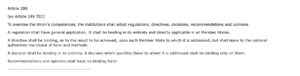
In EU law, there is a critical distinction between a Directive and a Regulation. A Directive requires member states to enact their own national legislation to achieve a particular result, giving governments some discretion in how they do so. A Regulation is an entirely different instrument. Under Article 288 of the Treaty on the Functioning of the European Union (TFEU), a Regulation is directly applicable in its entirety across all member states. It requires no transposition into national law. It creates binding obligations from the moment it enters into force. It cannot be partially applied, selectively enforced, or treated as optional guidance.
This distinction matters profoundly in the context of passport stamping. The rules governing the stamping of travel documents at Schengen borders do not appear in a directive, a guideline, or a recommendation. They appear in a Regulation — specifically, Regulation (EU) 2016/399 of the European Parliament and of the Council of 9 March 2016, known as the Schengen Borders Code.
THE LEGAL POSITION: ARTICLE 11(3)(G)
Article 11 of the Schengen Borders Code sets out the rules on the stamping of travel documents. Article 11(1) provides that the travel documents of third-country nationals shall be systematically stamped on entry and exit. However, Article 11(3) sets out express exemptions to this obligation, and it is unambiguous in its terms. It states:
“No entry or exit stamp shall be affixed … (g) to the travel documents of nationals of third countries who present a residence card provided for in Directive 2004/38/EC.”
The language is imperative. It does not say that a stamp “may” be withheld. It says no stamp “shall” be affixed. There is no discretion afforded to the border guard. There is no provision allowing a member state to derogate from this requirement. The obligation is absolute.
Furthermore, Article 11(3)(g) has remained unchanged through every amendment to the Schengen Borders Code since 2016, including the most recent amendment introduced by Regulation (EU) 2024/1717. The exemption is settled, confirmed, and in force.
WHO IS PROTECTED FROM STAMPING?
In the context of Spain, the exemption under Article 11(3)(g) applies to the following groups:
Non-EU nationals holding a valid Spanish residence card (Tarjeta de Identidad de Extranjero — TIE).
British nationals protected under the EU-UK Withdrawal Agreement (WA) who hold a biometric TIE card issued under that Agreement.
British nationals protected under the Withdrawal Agreement who hold a green registration certificate (Certificado de Registro de Ciudadano de la Union) — the pre-Brexit document issued to EEA nationals registered as residents in Spain.
In each case, presentation of the relevant residence document at the border should result in no stamp being affixed to the travel document. This is not a matter of border guard discretion. It is a legal obligation.
THE “NOT BIOMETRIC” EXCUSE: AN ARGUMENT THAT DOES NOT HOLD
A common justification offered by border guards when stamping the passports of Withdrawal Agreement residents holding a green certificate is that the document is not biometric and therefore cannot be verified in the same way as a TIE card. This argument is legally and factually without merit.
EU citizens residing in Spain hold the identical green registration certificate. They are routinely not stamped at Spanish borders. If the absence of biometric data were genuinely the reason for requiring a stamp, EU citizens holding the same non-biometric document would also be stamped. They are not.
The reason EU citizens are not stamped is their status as Union citizens exercising rights of free movement, not the format of their document. Withdrawal Agreement residents holding a green certificate have equivalent protected status and are equally exempt from stamping under Article 11(3)(g). The document format is irrelevant to the legal exemption.
BINDING IN LAW, TOOTHLESS IN PRACTICE
If Regulation (EU) 2016/399 is directly binding on Spain, and Article 11(3)(g) is unambiguous, why does wrongful stamping continue? The answer lies in the gap between the legal force of a regulation and the political reality of enforcement.
Where a member state fails to apply EU law correctly, the European Commission has the power under Article 258 TFEU to launch infringement proceedings. This process begins with a formal letter of notice, proceeds to a reasoned opinion, and may ultimately result in referral to the Court of Justice of the European Union (CJEU), which may impose financial penalties.
In practice, however, the Commission exercises significant discretion in deciding whether to bring proceedings, and that discretion is heavily influenced by political considerations. Border control is a politically sensitive area that touches directly on national sovereignty. Analysis by Investigate Europe has found that in more than 40 cases the Commission has allowed member states to escape any consequence for violations of EU law — including in cases where the CJEU had already determined that a breach had occurred.
The result is a familiar paradox: a regulation that is binding in law but effectively discretionary in enforcement. Member states are aware that the likelihood of Commission action over individual instances of wrongful passport stamping is negligible. This creates the conditions in which non-compliance persists.
THE COMMISSION’S OWN ROLE IN UNDERMINING THE REGULATION
The European Commission has itself contributed to the ambiguity. The primary context in which the stamping exemptions under Article 11(3) are communicated to border guards is the Schengen Border Guard Handbook, an operational guidance document issued by the Commission. This handbook frames the exemptions in the language of guidance and recommendation, rather than as the binding legal obligations they are.
The effect is that border guards may perceive the no-stamping rule as advisory rather than mandatory. The Commission has, in effect, used soft guidance language to communicate what is in reality a hard legal requirement. This failure to communicate the binding nature of Article 11(3)(g) with appropriate clarity has contributed directly to ongoing non-compliance.
THE PRACTICAL HARM TO RESIDENTS
The wrongful stamping of a resident’s passport is not merely a procedural inconvenience. It has substantive legal consequences. Article 12(1) of the Schengen Borders Code provides that where a travel document does not bear an entry stamp, the competent national authorities may presume that the holder does not fulfil the conditions of duration of stay applicable within the member state concerned.
In practice, this means that a resident whose passport has been incorrectly stamped on entry may find themselves presumed to be a short-stay visitor subject to the 90-day rule within any 180-day period. This can create serious difficulties in demonstrating legal residency, a burden that should never have arisen.
It is also worth noting that Article 11(3) itself acknowledges that stamping can cause serious difficulties. It provides that, at the request of a third-country national, a stamp may be dispensed with if its insertion might cause serious difficulties for that person. Residents who find themselves being stamped despite presenting their residence documentation are therefore entitled to invoke this provision directly.
WHAT RESIDENTS SHOULD KNOW AND DO
Always present your residence document at the border. The exemption under Article 11(3)(g) is conditional on presentation of the document.
If a border guard moves to stamp your passport, state clearly that you are a resident and that Article 11(3)(g) of Regulation (EU) 2016/399 exempts your travel document from stamping.
If the guard persists, you may wish to request to speak with a supervisor. Document the name or identification number of the border guard, the border crossing point, and the date and time. Most travellers would not have the time or inclination to do this.
If a stamp is wrongly applied, consider making a formal complaint to the Policia Nacional and, if appropriate, to the European Commission via the SOLVIT network, which handles cross-border problems caused by public authorities within the EU.
SO WHY ARE PASSPORTS BEING STAMPED?
Regulation (EU) 2016/399 is unambiguous. Article 11(3)(g) is clear. Residents in Spain holding a valid residence document, whether a biometric TIE card, a Withdrawal Agreement TIE, or a pre-Brexit green registration certificate, must not have their passports stamped at the border. This is not a recommendation. It is a binding obligation on every border guard in every Schengen member state.
The uncomfortable truth is that a regulation’s binding force is only as strong as the political will to enforce it. The European Commission has the tools to act against non-compliant member states but has consistently chosen not to do so in this area. Until that changes, the burden falls on residents themselves to know their rights, assert them at the border, and document breaches when they occur.
A regulation described as “binding in its entirety” that is routinely ignored without consequence is, in practice, toothless. That is not a reason for residents to accept wrongful stamping. It is a reason to understand precisely why it is happening — and to push back with the full weight of the law behind them.
Legal Reference: Regulation (EU) 2016/399 of the European Parliament and of the Council of 9 March 2016 on a Union Code on the rules governing the movement of persons across borders (Schengen Borders Code), as amended, consolidated version 12 October 2025.
All directives and Regulations, mentioned in my articles, are revised by me